Integrated Product Development — PACY2000A / PACY2001A
Acetylcysteine 20 % w/v Nebuliser Solution
A sterile aqueous mucolytic solution delivered by nebuliser, developed to loosen and clear viscous mucus secretions in respiratory disease. Formulated, manufactured and assayed as a single integrated exercise.
The challenge
Acetylcysteine's free thiol group is prone to oxidation, requiring careful control of antioxidant selection, pH, and exposure to air and light during formulation. This instability also defines the analytical requirements of the project: the HPLC-UV method must be capable of detecting degradation, not only quantifying the intact drug.
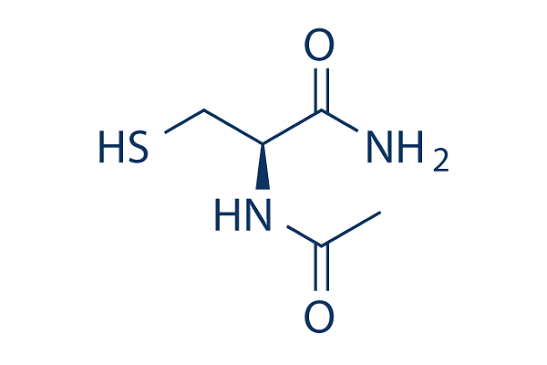
Two sides of one product
The formulation and the analytical method were developed together — each one shapes what the other has to do.
Part A
Pharmaceutics
Formulation of a stable 20 % w/v acetylcysteine solution, with emphasis on antioxidant selection, pH control, and packaging to limit oxidative degradation.
View formulation →Part B
Pharmaceutical chemistry
Validation of an HPLC-UV method for acetylcysteine quantification, referenced against the BP 2022 monograph and cross-checked by iodometric titration.
View method validation →Strength
20 % w/v
Reference monograph
BP 2022, Acetylcysteine Injection
Primary method
HPLC-UV
Cross-check
Iodimetric titration
Group members
Acetaminophen (paracetamol) is normally metabolised safely, but during an overdose the safe pathways saturate and the liver produces a toxic metabolite, NAPQI. NAPQI is usually neutralised by the liver's glutathione stores — in an overdose, these stores are rapidly depleted, and unbound NAPQI damages liver cells, causing nausea, vomiting, right-upper-quadrant pain and potentially fatal liver failure.
Remarkably, the very same vial of acetylcysteine used for a nebulising solution can be administered orally to treat this poisoning — ideally within 16 hours of the overdose. It acts as a life-saving antidote by supplying the exact chemical building blocks the liver needs to restore its glutathione levels, neutralising the NAPQI and protecting the liver (DailyMed, 2026).
A solution for injection can be used as a solution for nebulising, but a solution for nebulising cannot be used as a solution for injection. Although both solutions are sterile, non-pyrogenic, and formulated at a biological pH, the solution for injection is manufactured under stricter conditions and needs to ensure tonicity as well.
Due to the macrophages and mucus in the lungs, an additional defence mechanism exists that the bloodstream does not have, hence stricter regulations on substances injected directly into the bloodstream. The solution for injection manages to fill all the requirements for nebulising substances, resultingly we can use a solution for injection in a nebuliser — however the solution for nebulising fails to fill criteria for the solution for injection and consequently cannot be used for injecting.